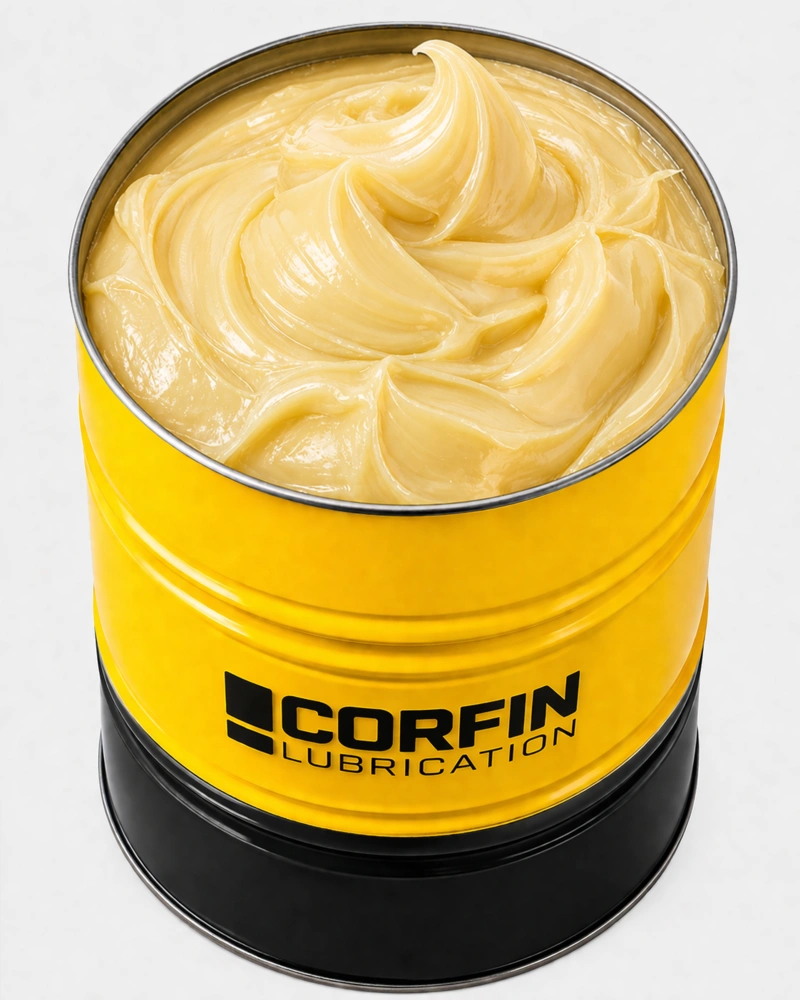
Synthetic high-speed grease is a grease suitable for high velocities. Ester base oil and lithium complex thickener were used in its production. It ensures that bearing systems are quieter and have higher performance during operation, even in environments with dynamic loads.
It is an ideal lubricating grease for all needle bearings operating at high and medium speeds. Corfin brand Uniflex-18 is a long-lasting and high-performance product that can be used in all systems where operating temperatures are very low and operating speeds are very high.
Speed grease, which has a wide range of uses, is used in needle bearings, spindles of machine tools, bearings of spinning turbines and lubrication of bearings of sensitive and optical devices where the sound level is required.
WHAT IS SPEED GREASE? Friction, wear and corrosion in mechanical systems can cause disruption of the production process and serious damage to machines. Lubrication using the optimum level of grease helps to carry out the production process without interruption. As a result, problems like this can only be solved by using quality speed grease.
The important thing before the application is to determine the requirements. Accordingly, what is important is the design and working principle of the machines to be applied. Afterwards, it is decided what type of lubricant should be used. Only by choosing the right high-speed grease can avoid the current challenges significantly.
For lubrication of bearings operating at low temperatures and high speeds
In bearings of cots in the textile industry
In bearings and bearing housings that are very difficult to lubricate and require special engineering knowledge
Corfin Unifex speed grease is used in all needle bearings that operate at high speeds.
It is used for lubricating bearings operating at low temperatures and high speeds, in the textile industry for the bearings of folding machines, and in precision bearings that are difficult to lubricate.
The technical specifications of UNIFLEX 18 grease, based on laboratory test results, are listed below. All values were measured under standard test conditions.
| ANALİZLER | STANDART | BİRİM | SONUÇ |
|---|---|---|---|
| Color | Beige | ||
| Appearance | Homogeneous | ||
| Thickener | Lithium Complex | ||
| Base Oil | Synthetic | ||
| Base Oil Viscosity (cst) at 40 °C | ASTM D445 | cst | 15 |
| Temperature Range | °C | -40 / 165 | |
| NLGI Class | 2 | ||
| Penetration | ASTM D217 | mm/10 | 265 – 295 |
| Dropping Point | ASTM D2265 | °C | > 235 |
| Seperation from Oil (% weight) 30 hours / 100 °C | ASTM D6184 | %wt | % 6,50 |
| Seperation from Oil (% weight) 7 days / 40 °C | IP 121 | %wt | 0,71 |
| Four Ball Test 1 hour /75 °C – 40kg (392 N) | ASTM D2266 | mm | <0,5 |
| Four-Ball EP Test 10 sec. / 1770 rpm Speed | ASTM D2596 | kg | 300 |
| Water Spray (% weight) | ASTM D4049 | %wt | %25 |
| Rust Test | ASTM D1743 | Pass | |
| Speed Factor (n x dm),[mm x min] | 1.000.000 |
Synthetic High Speed Grease is a synthetic oil based lithium complex thickened grease suitable for various applications and bearings due to its versatile properties and wide temperature range. It is a modern high performance synthetic grease suitable for industrial, marine and automotive applications. It is excellent for both high and low temperature, medium speed applications and heavy duty bearings in wet and corrosive environments. It provides a high degree of mechanical stability which improves performance in vibrating enclosures and extends relubrication intervals.
Synthetic High Speed Grease is an extreme pressure grease specially formulated for wet service. It is formulated from high quality synthetic base oils and calcium sulfonate complex thickeners to provide exceptional film strength, shear resistance, adhesion and mechanical stability. Formulated with superior wet service performance, extra durable coupling and adhesion chemistry. It holds together when exposed to water and adheres tenaciously to metal surfaces when wet, protecting components when exposed to prolonged standing or pressurized water.
Synthetic greases are created through complex processes, including being chemically developed from petrochemicals to have the exact molecular qualities required for a specific application. These processes remove impurities from the crude oil and allow individual molecules to be applied according to the demands of modern engines. These customized molecules in synthetic greases provide a higher level of performance and protection than conventional oils. Several advantages can be achieved by using a synthetic grease, including better temperature performance, longer oil change intervals and better fuel economy. A synthetic may cost more initially, but eventually the benefits will bring the total cost down. As mentioned, synthetic greases can provide improved low and high temperature performance. Synthetic grease also has better resistance to oxidation, thermal degradation and sludge. While conventional greases have more frequent lubrication intervals, a synthetic can last much longer. With longer oil change intervals, you can compensate for your initial investment in synthetic grease.
Greases are created by combining an oil with a gelling agent, usually a soap or a clay. It is the oil in the mixture that provides lubrication. The force created by two mating parts-e.g., slide on slide, sprocket on sprocket, ball bearing against raceway-compels oil from the gelator and onto the parts to reduce friction and prevent wear. Experts generally recommend grease for heavier loads, especially where vibration or shock loading is likely. They also resist washing out with water better than oils and effectively seal contaminants and moisture. Even on low-power devices, don’t immediately ignore grease. Greases stay where you put them, which can reduce the costs associated with manufacturing airtight oil chambers. Light, low-shear greases formulated with light oils, special gelling techniques, and adherence modifiers can become almost semi-liquid under shear. Therefore, for all but low-power devices, a specially formulated, extra-light grease may be more economical than an oil.




 -40 / 165 °C wide operating temperature range
  Contact



 NSF certified
